
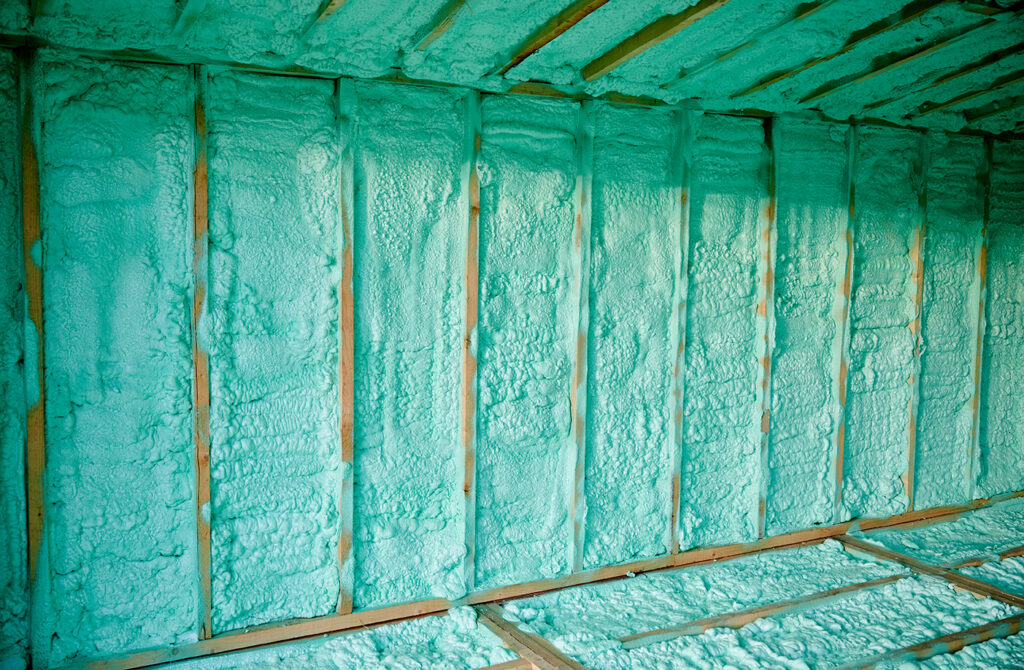
When precision, performance, and compliance matter, UltraTite 2000 delivers. This two-component, closed-cell polyurethane foam system is engineered for contractors and design professionals who demand high thermal efficiency, structural integrity, and environmental responsibility in one product.
High-Performance Building Envelope
UltraTite 2000 enhances the overall performance of the building envelope by creating a seamless, air- and moisture-resistant barrier. The closed-cell structure provides an exceptional R-value per inch, reducing heat loss while increasing building durability. Its self-adhering nature ensures uniform coverage and minimal voids, eliminating thermal bridging and uncontrolled air infiltration.
Versatile Application Across Substrates
Engineered for real-world jobsite flexibility, UltraTite 2000 adheres to a wide range of substrates including plywood, OSB, wood studs, concrete, metal studs, ductwork, and metal panels. Whether applied to interior or exterior surfaces, it maintains adhesion and performance consistency—critical for both retrofit and new-construction projects.
Code-Compliant and Job-Ready
UltraTite 2000 meets the 2021 IRC and IBC code requirements for Types I–V construction, giving contractors peace of mind that installations meet modern building standards. It’s suitable for commercial, residential, agricultural, and industrial applications, simplifying product selection across multiple project types.
Environmentally Responsible Formulation
Beyond performance, UltraTite 2000 advances sustainability. Utilizing an HFO blowing agent with zero ozone depletion potential and a global warming potential (GWP) below 1, it aligns with today’s stricter environmental regulations and green-building initiatives. Contractors can meet energy-efficiency targets and environmental benchmarks without compromising installation quality or curing performance.
Built for Efficiency and Longevity
Once applied, UltraTite 2000 contributes to a tighter, stronger building envelope that resists moisture intrusion, enhances indoor comfort, and extends the lifespan of the structure. Its rigidity and dimensional stability also add structural support—an advantage over open-cell alternatives in demanding environments.
